
Nepal is rich in renewable energy resources. Although hydropower is heavily promoted as an energy source, Nepal has enormous untapped solar potential. The nation has the potential to generate up to 552 TWh/year. By integrating solar with battery storage systems, electricity can be used during peak demand hours. However, due to a lack of government policies and public awareness, solar energy with battery storage systems is not properly utilized.
Nepal’s heavy dependence on hydropower makes it vulnerable to climate change. Decreased river water flow in the dry season, disrupted precipitation patterns, glacier melt, and disasters like floods, landslides, and GLOFs impact electricity generation, damage infrastructure, and cause economic losses. In recent years, Nepal’s electricity exports have increased significantly. Despite this, Nepal is unable to gain high economic benefits because it imports electricity at higher rates during dry season and peak demand hours.
Battery Energy Storage Systems (BESS) offer a solution for these challenges. Solar energy can be stored in batteries and utilised during peak demand hours, dry seasons, and climate-induced disruptions. Stored surplus energy can be strategically exported to India at higher rates. Standalone batteries can also be deployed at substations in urban and industrial areas where surplus hydropower can be stored and later discharged during periods of high demand, reducing energy wastage and improving reliability.
Battery systems can also improve grid operations in regions facing transmission constraints. By absorbing or injecting power when needed, BESS can reduce congestion, balance loads, and defer costly transmission infrastructure upgrades.
The falling cost of batteries is making energy storage increasingly attractive. Lithium-ion battery costs have declined by approximately 97% since 1991 and reached around USD 108/kWh in 2025. For projects where batteries account for 50% of the energy storage requirement and are charged through daytime solar generation while supplying power during morning and evening peaks, installation costs are estimated at approximately NPR 80–85 million per MW in 2025.
Nepal’s rapidly growing electric vehicle market also presents opportunities for energy storage integration. In FY 2081/82, Nepal imported 44,509 EVs. Retired EV batteries can be repurposed for stationary storage applications, supporting grid operations and backup power systems. Such second-life battery applications promote a circular economy, improve affordability, and support renewable energy integration.
The country is gradually moving toward battery storage adoption. Two major grid-connected solar PV projects with battery storage are currently in the initial development phase under Investment Board Nepal. The Nepal Electricity Authority is planning four solar projects with BESS in Karnali Province, while private developers have also secured survey licenses for solar-plus-storage projects.
Despite growing interest, development remains constrained by the absence of clear policies, tariff structures, subsidies, and implementation mechanisms. The Government of Nepal announced in the FY 2082/83 budget that grid-connected solar and wind projects with battery storage would receive PPAs similar to storage-based hydropower projects, but implementation frameworks have yet to be established. Likewise, the FY 2083/84 budget announced plans to install 100 MW of BESS in the Kathmandu Valley, although implementation progress remains uncertain.
International experience demonstrates the importance of policy support. In 2024, multiple provinces in China introduced policies requiring renewable energy projects to allocate 10–20% of installed capacity to energy storage systems and provided incentives for second-life battery projects. India has also introduced Viability Gap Funding (VGF) covering up to 40% of capital costs for BESS projects.
To accelerate deployment, Nepal should establish a comprehensive policy framework, including dedicated regulations for battery storage projects, long-term PPAs, targeted subsidies, tax incentives, concessional financing mechanisms, and policies promoting second-life battery applications. Such measures would encourage private sector participation and support wider adoption of energy storage technologies.
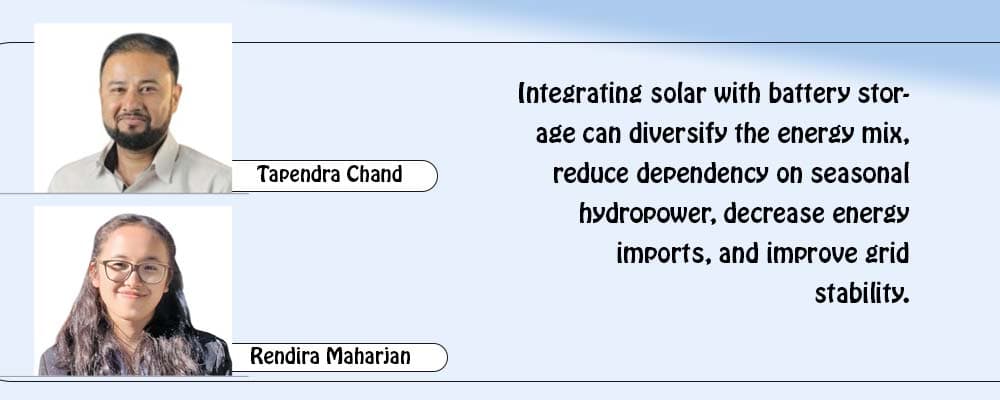
Integrating solar energy with battery storage can diversify Nepal’s energy mix, reduce dependence on seasonal hydropower, lower electricity imports, improve grid stability, and create new economic opportunities through energy trading and battery reuse. A strong policy framework will be essential to unlocking these benefits and building a more reliable, resilient, and sustainable energy system.
Share this article